Relevance: primary · Type: background
Confidence100%
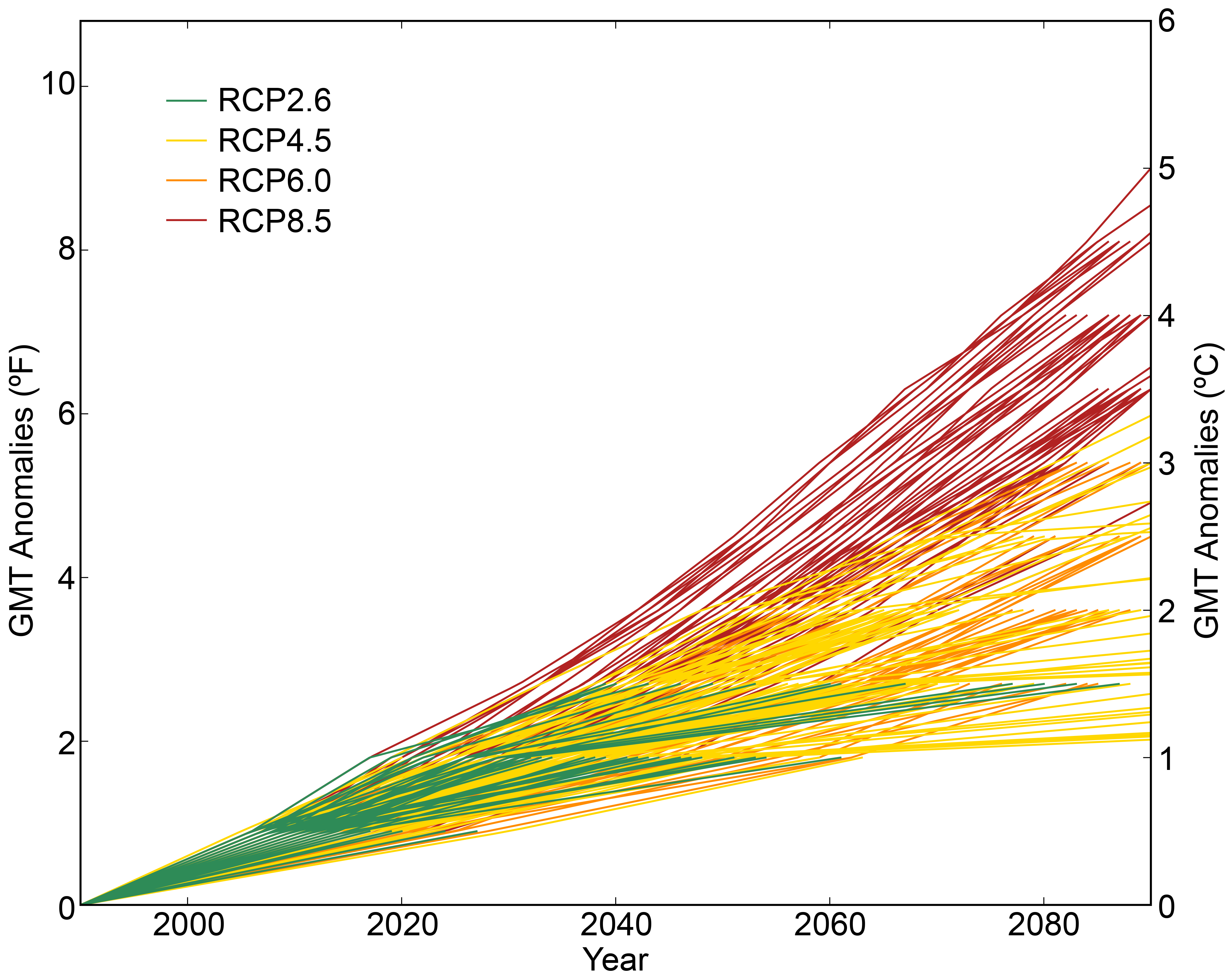
RCP 8.5 is a climate scenario that assumed humans would continue burning fossil fuels with abandon through the 21st century, resulting in global warming of almost 5 degrees Celsius above preindustrial levels.
Relevance: supporting · Type: background
Confidence100%
Under the RCP 8.5 scenario, Florida’s coastline would disappear underwater, sub-Saharan Africa would see more than 85 million climate migrants by 2050, and half of the world’s plant and animal species would go extinct.
Relevance: primary · Type: event
Confidence100%
In April 2026, leading scientists for the United Nations Intergovernmental Panel on Climate Change (IPCC) announced that RCP 8.5 is no longer a reasonable prediction due to the growth of renewable energy and climate policies.
Relevance: supporting · Type: background
Confidence100%
RCP 8.5 was one of four Representative Concentration Pathways used to measure solar energy trapped in Earth’s atmosphere under different greenhouse gas emission levels.
Relevance: supporting · Type: background
Confidence90%
Some scientists have argued that RCP 8.5 was never indicative of any plausible future and was disingenuously promoted by climate activists for its alarming impact.
Zeke Hausfather, climate scientist
Relevance: primary · Type: quote
Confidence100%
Zeke Hausfather stated, "After [RCP 8.5] was created, through a game of telephone, people started calling it the ‘business as usual’ scenario."
Zeke Hausfather, climate scientist
Relevance: primary · Type: quote
Confidence100%
Zeke Hausfather stated, "It’s useful to have worst-case scenarios. The problem for a while is that people were conflating the worst case with the most likely outcome."
Relevance: supporting · Type: background
Confidence100%
RCP 8.5 was published in 2011 and assumed an unprecedented fivefold increase in coal use by 2100.
Zeke Hausfather, climate scientist
Relevance: primary · Type: quote
Confidence100%
Zeke Hausfather stated, "Two things can be true. The [RCP 8.5] scenario was never intended to be the most likely outcome, and we also have made progress in making high-end scenarios less likely because of falling costs of clean energy, increasing global investments in clean energy, and moving away from fossil fuels."
Relevance: supporting · Type: background
Confidence90%
Some climate scientists believe studies based on RCP 8.5 were a waste of time and distracted from analyzing more moderate, relevant scenarios.
Steven Koonin, former Under Secretary for Science, Department of Energy
Relevance: supporting · Type: quote
Confidence100%
Steven Koonin stated that RCP 8.5 was merely a way to test climate models under extreme stress, similar to an engineer simulating 250 army tanks on a bridge.
Steven Koonin, former Under Secretary for Science, Department of Energy
Relevance: supporting · Type: quote
Confidence100%
Steven Koonin said some activists, journalists, and scientists used RCP 8.5 to scare the public into reducing emissions and that some "destroyed the reputations of scientists who dared to say, ‘Wait a minute.’"
Chris Field, climate scientist at Stanford University
Relevance: supporting · Type: quote
Confidence100%
Chris Field stated, "We wanted to understand a wide range. It’s important to recognize that no one in the climate community, certainly not the climate modelers or economists, know what the future trajectory of emissions will be."
Relevance: supporting · Type: background
Confidence100%
Chris Field refuted claims that the scientific community deliberately misled people or promoted climate action by emphasizing RCP 8.5.
Relevance: primary · Type: background
Confidence100%
Under current emission trends, the planet is projected to follow RCP 4.5, a middle scenario expected to result in up to 3 degrees Celsius of global warming.
Zeke Hausfather, climate scientist
Relevance: supporting · Type: quote
Confidence100%
Zeke Hausfather stated, "[RCP 4.5] is still a very bad outcome."
Relevance: supporting · Type: background
Confidence100%
At 2 degrees Celsius of warming, studies suggest a greater likelihood of ecological damage, including ocean coral reef collapse.
Relevance: supporting · Type: background
Confidence100%
Studies suggest that as many as 1 in 4 plant and animal species in the Amazon rainforest and Galápagos Islands could face local extinction with 2 degrees Celsius of warming.
Relevance: supporting · Type: background
Confidence100%
Extreme heat from climate change could impact millions more people and challenge global food systems.
Relevance: supporting · Type: background
Confidence100%
The RCP 4.5 scenario assumes the world continues reducing coal use and flattening then decreasing fossil fuel consumption.
Relevance: supporting · Type: background
Confidence100%
Some coal proponents, including President Donald Trump, celebrated the retirement of RCP 8.5 as evidence that climate concerns are overblown.
Relevance: primary · Type: background
Confidence100%
Climate scientists say the retirement of RCP 8.5 is not a reason to reduce clean-energy efforts.
Relevance: supporting · Type: background
Confidence90%
Some scientists argue that activists who presented RCP 8.5 as the most likely outcome may have had the opposite of their intended effect on public perception.
Relevance: supporting · Type: background
Confidence100%
Quico Toro with the Anthropocene Institute compared RCP 8.5 to an engineer simulating 250 army tanks on a bridge—an implausible but informative stress test.
Relevance: supporting · Type: background
Confidence100%
Zeke Hausfather co-authored a 2020 paper arguing that RCP 8.5 was being incorrectly interpreted as the default future without climate mitigation.



forum Comments (0)
No comments yet. Be the first to comment.