Relevance: primary · Type: event
Confidence99%
A new study published June 3 in Microbiome identified cold-adapted yeasts on Ötzi the Iceman’s remains that may have colonized him during his glacial preservation.
Relevance: supporting · Type: event
Confidence99%
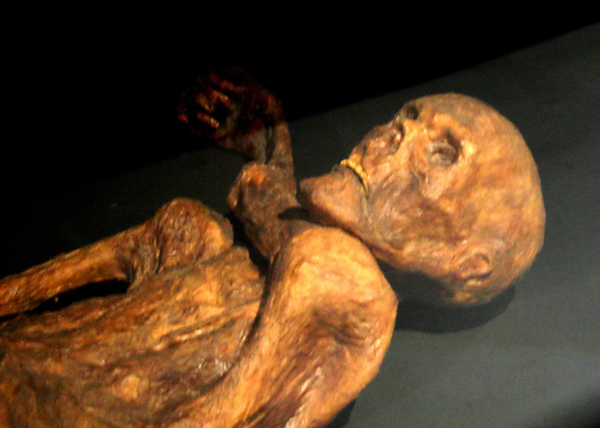
Researchers found genetic traces of gut microbes that Ötzi the Iceman died with approximately 5,300 years ago.
Relevance: supporting · Type: background
Confidence99%
Ötzi the Iceman’s remains are stored in a specialized facility in Italy at –6° Celsius to simulate glacial conditions and prevent degradation.
Relevance: supporting · Type: action
Confidence99%
Researchers thawed Ötzi’s remains to 4° Celsius for five hours and collected the resulting runoff.
Relevance: supporting · Type: action
Confidence99%
Researchers took swabs from Ötzi’s body at key locations and collected samples of his skin and other tissues.
Relevance: supporting · Type: action
Confidence99%
Researchers analyzed soil from the glacier where Ötzi was discovered, the air in the museum, and the water used to humidify his storage chamber.
Relevance: primary · Type: event
Confidence99%
Researchers grew living colonies from four species of yeast found in Ötzi the Iceman’s body.
Relevance: supporting · Type: background
Confidence95%
The four viable yeast species are considered 'relicts' or living time capsules from Ötzi’s time in the ice after his death.
Relevance: supporting · Type: event
Confidence99%
Cultures from Ötzi’s internal bacteria did not grow in laboratory attempts.
Relevance: primary · Type: quote
Confidence95%
The viable yeast cultures suggest Ötzi 'is not a static relic but a dynamic biological interface.'
Albert Zink, anthropologist
Relevance: primary · Type: quote
Confidence99%
Albert Zink, an anthropologist formerly with the Eurac research center and now at Ludwig Maximilian University of Munich, said, 'We also found ancient DNA from these species, which proves that they persisted in Ötzi and accompanied him over thousands of years while he was preserved in the ice.'
Relevance: supporting · Type: background
Confidence95%
Scientists believe Ötzi’s remains thawed and refroze several times, especially in the first 1,500 years after his death.
Patrick Hunt, Alpine archaeologist
Relevance: supporting · Type: quote
Confidence99%
Patrick Hunt of Stanford University, an Alpine archaeologist not involved in the study, said the conclusion that Ötzi is a 'dynamic biological interface' is 'right on the mark.'
Patrick Hunt, Alpine archaeologist
Relevance: supporting · Type: quote
Confidence99%
Patrick Hunt said, 'Ötzi’s remains are the most important archaeological science finding of the 20th century and up until the present.'
Mohamed Sarhan, microbiologist
Relevance: supporting · Type: quote
Confidence99%
Mohamed Sarhan, a microbiologist at the Eurac Research Institute for Mummy Studies, said, 'It worked. As a dough, it was very very good,' referring to preliminary tests using Ötzi’s yeasts for sourdough bread.
Mohamed Sarhan, microbiologist
Relevance: supporting · Type: quote
Confidence99%
Mohamed Sarhan indicated that the yeasts from Ötzi’s remains could potentially be cultivated by fermentation industries for making bread or beer.
Relevance: supporting · Type: background
Confidence95%
Previous research identified gut microbes in Ötzi similar to those found in non-Westernized communities such as the Hadza hunter-gatherers in Tanzania and people in north-eastern Madagascar.
Relevance: supporting · Type: action
Confidence99%
In 2019, researchers began studying swab and water samples from Ötzi’s internal and external microbiome, soil from the discovery site, and his storage environment.
Relevance: supporting · Type: background
Confidence95%
Ötzi’s skin microbiome has been 'directly and dominantly shaped' by conservation techniques used during preservation efforts.
Relevance: supporting · Type: background
Confidence95%
Evidence of ancient DNA damage in the yeasts suggests they either remained dormant for 5,300 years or are descendants of the original colonizers.
Relevance: supporting · Type: event
Confidence95%
Comparison of skin samples from 2010 and 2019 showed that the cold-loving yeast Glaciozyma became the dominant strain over that period.
Frank Maixner, director of the Eurac Research Institute for Mummy Studies
Relevance: supporting · Type: quote
Confidence99%
Frank Maixner, director of the Eurac Research Institute for Mummy Studies, said, 'These yeasts have accompanied Ötzi on his long journey through the millennia.'
Frank Maixner, director of the Eurac Research Institute for Mummy Studies
Relevance: supporting · Type: quote
Confidence99%
Frank Maixner stated that Ötzi is 'not a static relic, but a dynamic biological system.'
Mohamed Sarhan, microbiologist
Relevance: supporting · Type: quote
Confidence99%
Mohamed Sarhan emphasized that Ötzi provides only 'a snapshot [of] one individual' and may not represent all people from the Copper Age.
Patrick Hunt, Alpine archaeologist
Relevance: supporting · Type: quote
Confidence99%
Patrick Hunt stated that the team’s 'analytical findings on ongoing microbial contamination are vital to whatever interventions are needed' for the preservation of Ötzi’s remains.
Relevance: supporting · Type: background
Confidence95%
It is currently unclear whether modern microbes introduced during conservation or the ancient yeasts are harming the preservation of Ötzi’s remains.
Relevance: supporting · Type: background
Confidence95%
The study notes there could be a danger of decomposition if the yeasts are not kept frozen.



forum Comments (0)
No comments yet. Be the first to comment.