
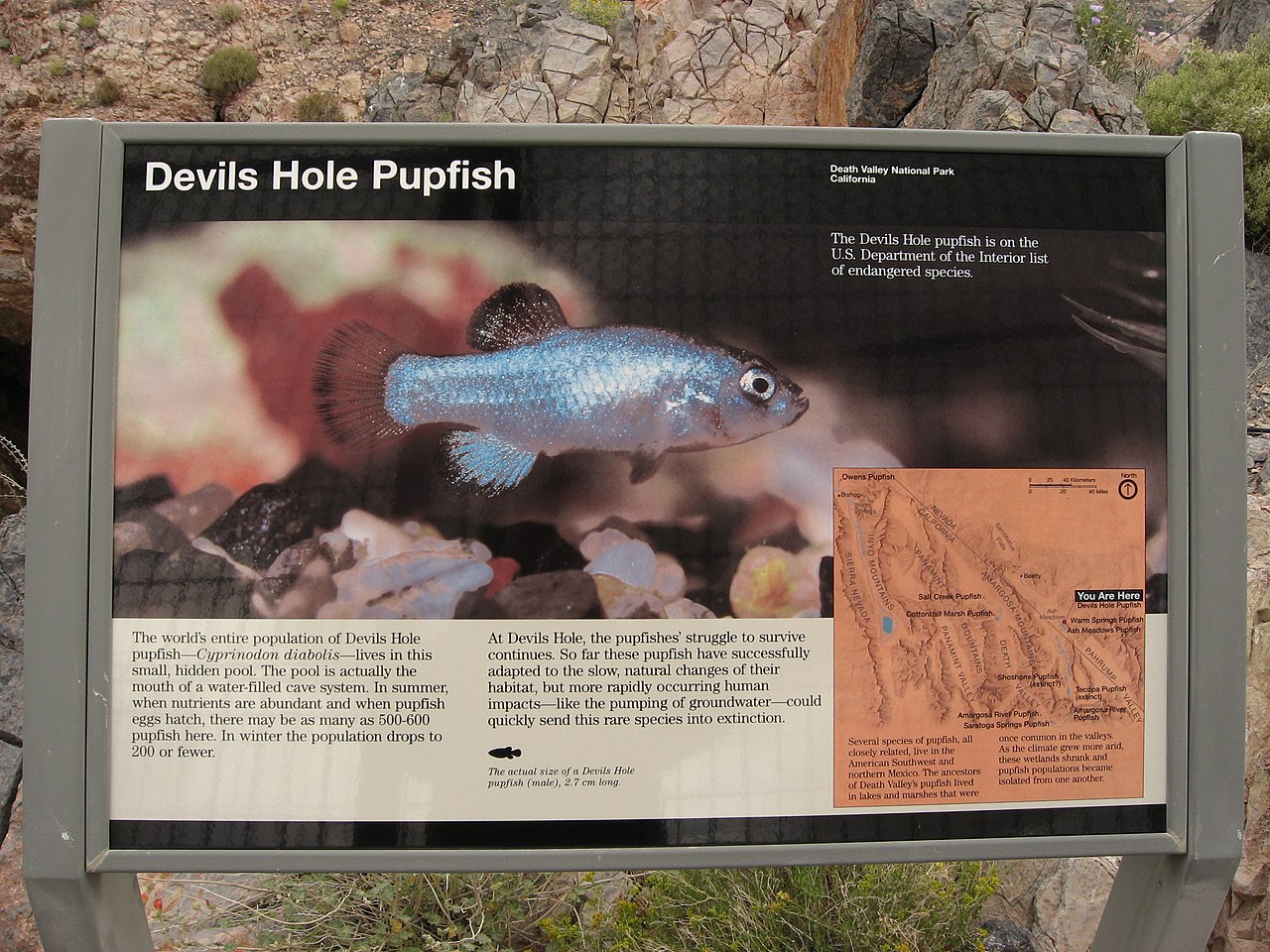
DEATH VALLEY NATIONAL PARK — Wildlife managers released captive-bred Devils Hole pupfish into Devils Hole in Death Valley National Park for the first time in spring 2026, lifting the observed population to 77 individuals. The introductions followed a sharp decline that left only 20 wild fish in the cavern pool by late February 2025.
Managers initially placed 19 captive-bred pupfish into the pool and later added about 50 more. Biologists counted 77 pupfish in Devils Hole during the spring 2026 survey.
The Devils Hole pupfish lives in a single deep pool of hot water at the bottom of a cavern in Death Valley National Park. The water is nutrient- and oxygen-poor and maintains a temperature of 93 degrees Fahrenheit. "Devils Hole is considered probably the smallest known habitat for a vertebrate species," said Kevin Wilson, supervisory biologist at Death Valley National Park.
The cavern held 212 pupfish in the fall 2024 count before the population fell to 20 by late February 2025. In December 2024 and February 2025, distant earthquakes generated seismic waves that triggered mini-tsunamis inside Devils Hole, sweeping sediments and algae from the shallow rocky shelf where the fish feed and spawn. A magnitude 7.6 earthquake in Mexico in September 2022 had previously triggered a mini-tsunami in the pool that cleared algae.
"We went from record-high numbers to the lowest that we've ever counted," said Olin Feuerbacher, a biologist with the U.S. Fish and Wildlife Service.
The team did not collect genetic samples from the first batch of captive-bred pupfish before release. Without that data, scientists cannot distinguish the introduced fish from wild individuals or track their contributions to future generations. "Choices between delaying action to do things perfectly, or doing the best we could within the perceived time constraints, and generally we decided that the benefits of rapid action outweighed the benefits of waiting," Feuerbacher said.
Officials have monitored the population every spring and fall for decades. The count reached a low of 35 individuals in 2013, the same year biologists began breeding a backup population at the Ash Meadows Fish Conservation Facility in a 100,000-gallon tank replicating the Devils Hole habitat. Officials have also added supplemental food to the pool since 2007.
"I think we saved the species," said Michael Schwemm, a biologist with the U.S. Fish and Wildlife Service.


forum Comments (0)
No comments yet. Be the first to comment.