
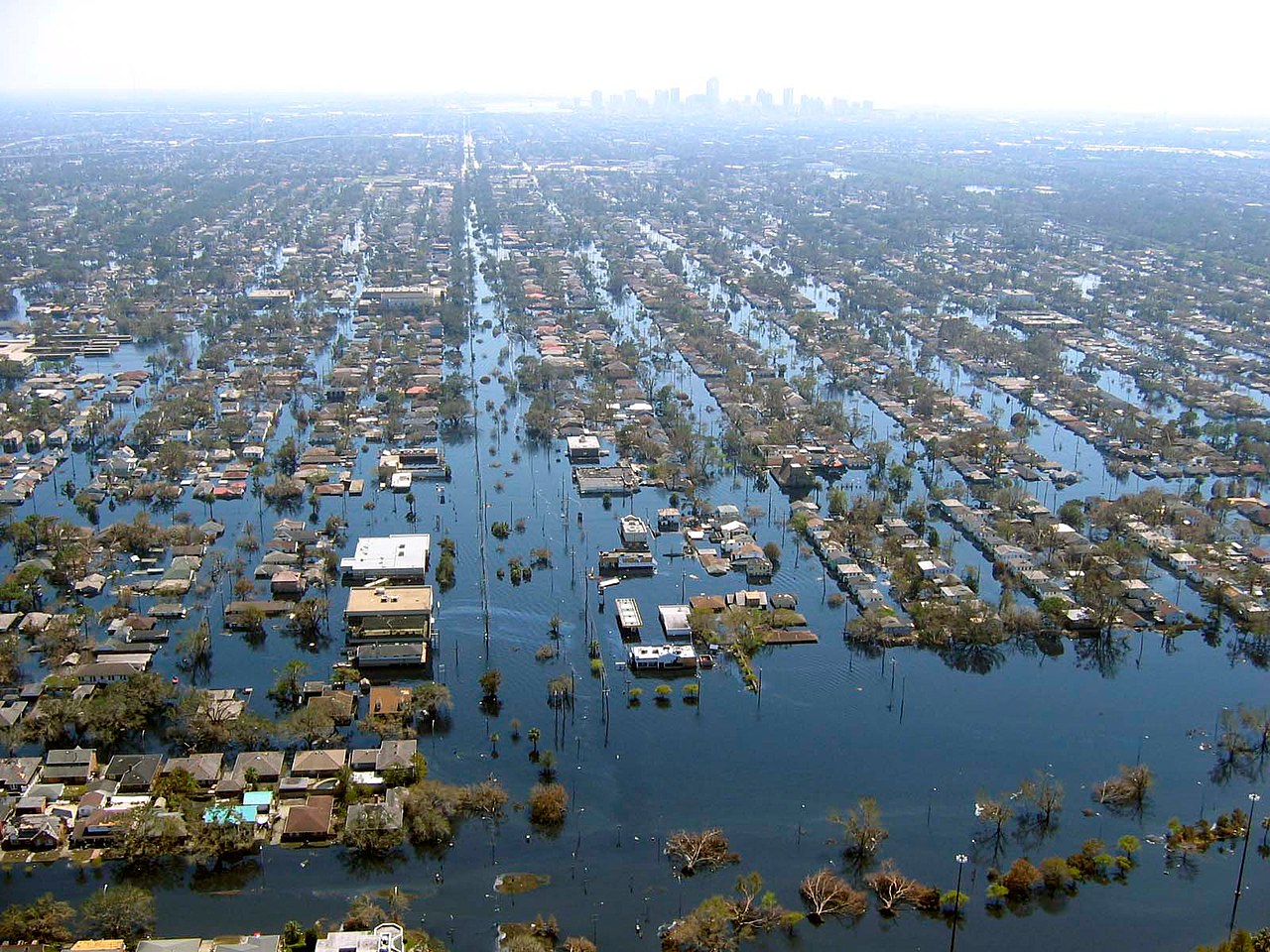
NEW ORLEANS — A perspectives paper published in Nature Sustainability concluded that New Orleans has reached a "point of no return" and will be surrounded by ocean within decades due to ongoing sea level rise and erosion of wetlands. The paper recommended that relocation of residents from the city begin immediately, starting with the most vulnerable communities.
The study projected that southern Louisiana will experience 3 to 7 metres of sea level rise and lose three-quarters of its remaining coastal wetlands, with the shoreline migrating as much as 100 kilometres inland and stranding both New Orleans and Baton Rouge. The researchers stated that southern Louisiana is the most physically vulnerable coastal zone in the world, and compared today's rising global temperatures with a period of similar heat 125,000 years ago that caused a rise in sea level. The paper estimated that New Orleans may be surrounded by the Gulf of Mexico before the end of this century.
"In paleo-climate terms, New Orleans is gone; the question is how long it has," said Jesse Keenan, an expert in climate adaptation at Tulane University and an author of the paper. "How long is not certain but it's most likely decades rather than centuries. Even if you stopped climate change today, New Orleans's days are still numbered. It will be surrounded by open water, and you can't keep an island situated below sea level afloat."
Keenan said political leaders had been reluctant to speak openly about the prospect. "No politician wants to first give this terminal diagnosis. They will speak about it behind closed doors, but never in public," he said.
New Orleans, a city of about 360,000 residents, sits in a bowl-shaped basin below sea level. Ninety-nine percent of its population is at major risk of severe flooding, the highest exposure of any U.S. city. Since 2005, billions of dollars have been spent to fortify the city with levees, floodgates, and pumps, but the paper warned that those defenses, which already require substantial upgrades, will not save the city in the long run. Since the 1930s, Louisiana has lost 2,000 square miles of land to coastal erosion, with another 3,000 square miles set to vanish over the next 50 years, a rate equivalent to a football-pitch-sized area every 100 minutes.
"Even compared to all other US cities, New Orleans really stands out, which is alarming," said Wanyun Shao, a geographer at the University of Alabama. "There is no specific timeline to how long New Orleans has left but we know it's in big trouble. They are facing one of the highest sea level rises in the world and I don't know how long human effort can fight against that tide. It's like a timebomb."
"I know it's a politically and emotionally charged issue, there are people with a deep attachment to New Orleans," Shao said. "But managed retreat, no matter how unappealing it may be, is the ultimate solution at some point."
The Mid-Barataria Sediment Diversion project, funded via a settlement from BP over the 2010 Deepwater Horizon disaster, broke ground in 2023 and was estimated to create more than 20 square miles of new land over 50 years. Governor Jeff Landry scrapped the project in 2022, arguing that its $3 billion cost was too high and that it threatened the state's fishing industry. "This level of spending is unsustainable," Landry said. The research paper stated that the loss of the sediment diversion plan would effectively mean abandoning extensive portions of coastal Louisiana, including the New Orleans area.


forum Comments (0)
No comments yet. Be the first to comment.