

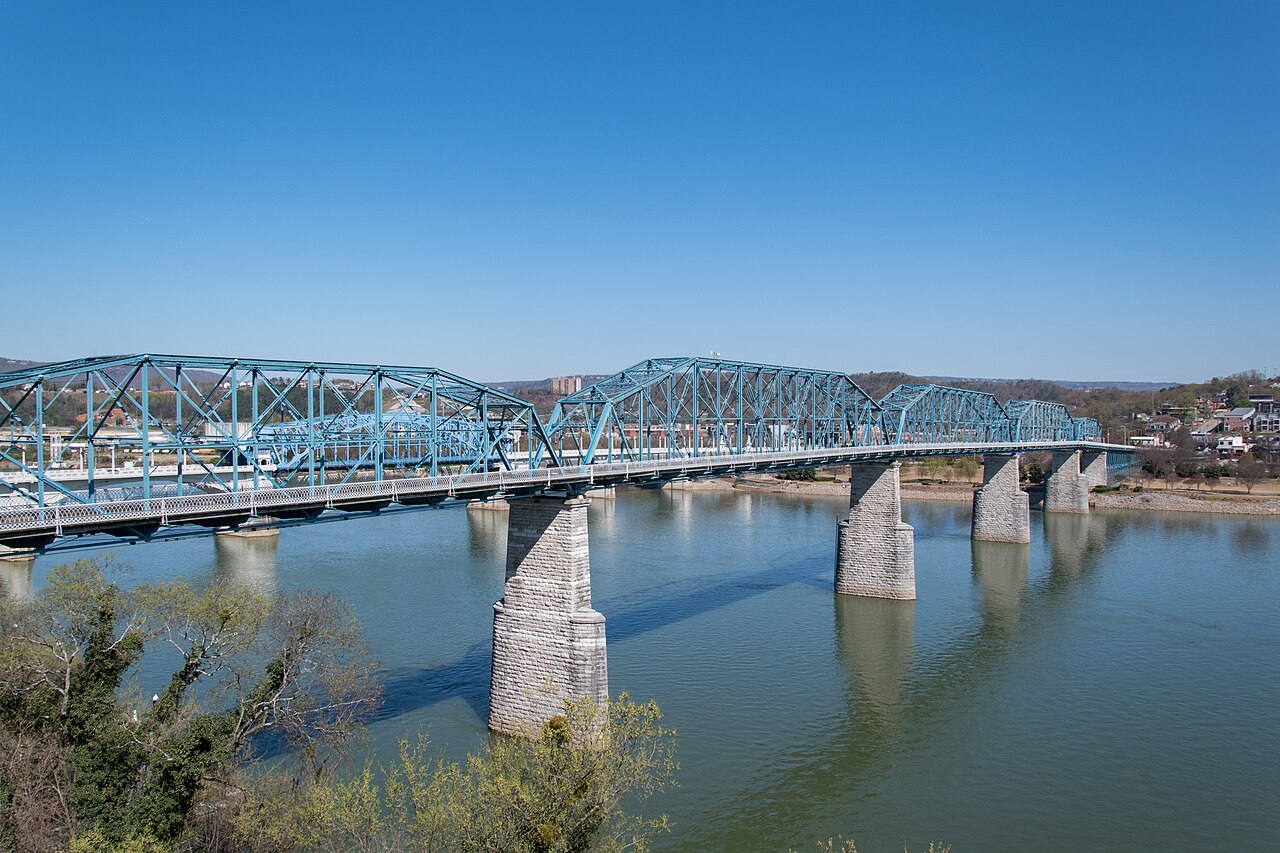
CHATTANOOGA — The Walnut Street Bridge in Chattanooga held a grand reopening on Saturday, October 3, 2026, following a decades-long preservation effort. Attorney Hank Hill and architect Garnet Chapin attended the ceremony marking the return of the historic structure.
The bridge dates to 1891 and is listed among the top 10 most beloved public spaces in America. Preservation efforts began after the bridge was closed for safety reasons in 1978. Landmarks Chattanooga, a local preservation organization, spearheaded the campaign to save the structure. Preservationist Bradley Curry urged Garnet Chapin to speak with Mayor Pat Rose about saving the bridge, but Rose stated that money to save the bridge was not available.
Hank Hill was part of a group that sued to stop the demolition of the Walnut Street Bridge two days before it was scheduled to start. Hill previously won a legal case in 1978 that delayed the construction of the Tellico Dam to protect the endangered snail darter. The Tellico Dam was eventually built and the Little Tennessee River was flooded.
Cornerstones, Inc. formerly Landmarks Chattanooga, helped fund a new engineering study for the Walnut Street Bridge. An initial engineering study projected an $8.5 million cost for the restoration. Structural engineer Al Lichtenstein examined the Walnut Street Bridge and found it had been closed for eight years with rotted or missing sidewalk planks.
Lichtenstein convinced Garnet Chapin to buy new high-strength cable instead of using discarded steel cables from the Incline Railway. The proposed design involved installing high-strength cable connecting the top chord members, leading below the deck, and back to the top chord on the opposite end of each truss section. The Lichtenstein firm provided a new estimate for the cable resupport design that reduced the projected cost from $8.5 million to approximately $4.5 million.
The Chattanooga Hamilton County Parks Foundation and Chattanooga Venture organized a project to light up the Walnut Street Bridge to raise awareness. Leslie Buttram Johnston led a fund drive to acquire lights for the bridge. Garnet Chapin, Jonathan Exum, and volunteers installed lights on the Walnut Street Bridge using a bucket truck.
The lights on the Walnut Street Bridge were turned on just before the 1988 Riverbend Festival. "That was one of the things that really turned people's attention to what a jewel we had in the Walnut Street Bridge," Mr said.
Mayor Gene Roberts asked Chattanooga Venture to establish an advisory committee to study the feasibility of converting the bridge to a linear park. Ben Probasco headed the advisory committee studying the Walnut Street Bridge conversion. The Bluff Furnace Association funded a trip by Mayor Roberts and others to seek federal support from Congresswoman Marilyn Lloyd and Senator Al Gore.
Congresswoman Marilyn Lloyd enlisted the assistance of Senator Frank Lautenberg to help secure federal funding for the bridge. Both houses of Congress passed a $2.5 million matching grant to save the Walnut Street Bridge.
Why It Matters
The reopening concludes a preservation campaign that prevented the demolition of a rare 19th-century engineering structure. The use of high-strength cable reinforcement reduced restoration costs, demonstrating a viable model for saving historic infrastructure. Federal designation and funding were components in securing the bridge's future.
Timeline
The Walnut Street Bridge held a grand reopening on Saturday, October 3, 2026. Attorney Hank Hill and architect Garnet Chapin attended the grand reopening of the Walnut Street Bridge. The Walnut Street Bridge reopening event was scheduled for Saturday, October 3, 2026. The Walnut Street Bridge was reopened on October 3, 2026, after a major restoration project.
What's New
Garnet Chapin, the architect who led the effort to save the Walnut Street Bridge, also played a key role in the preservation of the Chattanooga Choo Choo Hotel, another iconic local landmark, in the 1980s. The use of high-strength cable to reinforce the Walnut Street Bridge, proposed by Al Lichtenstein, was a novel engineering solution that reduced the restoration cost by nearly 50%, making the project financially viable for the city. Al Lichtenstein, the structural engineer who re-evaluated the Walnut Street Bridge, had previously worked on historic bridge projects such as the restoration of the Brooklyn Bridge in New York City.
The Federal Bridge Replacement Act allocated $400,000 for the demolition of the Walnut Street Bridge, but this funding was later redirected after the bridge was deemed eligible for the National Register of Historic Places. The Walnut Street Bridge was listed on the National Register of Historic Places in 1990, which played a critical role in preventing its demolition under the Federal Bridge Replacement Act. The $2.5 million federal matching grant secured for the Walnut Street Bridge in 1980 was part of a broader initiative under the National Historic Preservation Act, which provided funding for the preservation of over 500 historic bridges nationwide during the 1980s.


forum Comments (0)
No comments yet. Be the first to comment.