
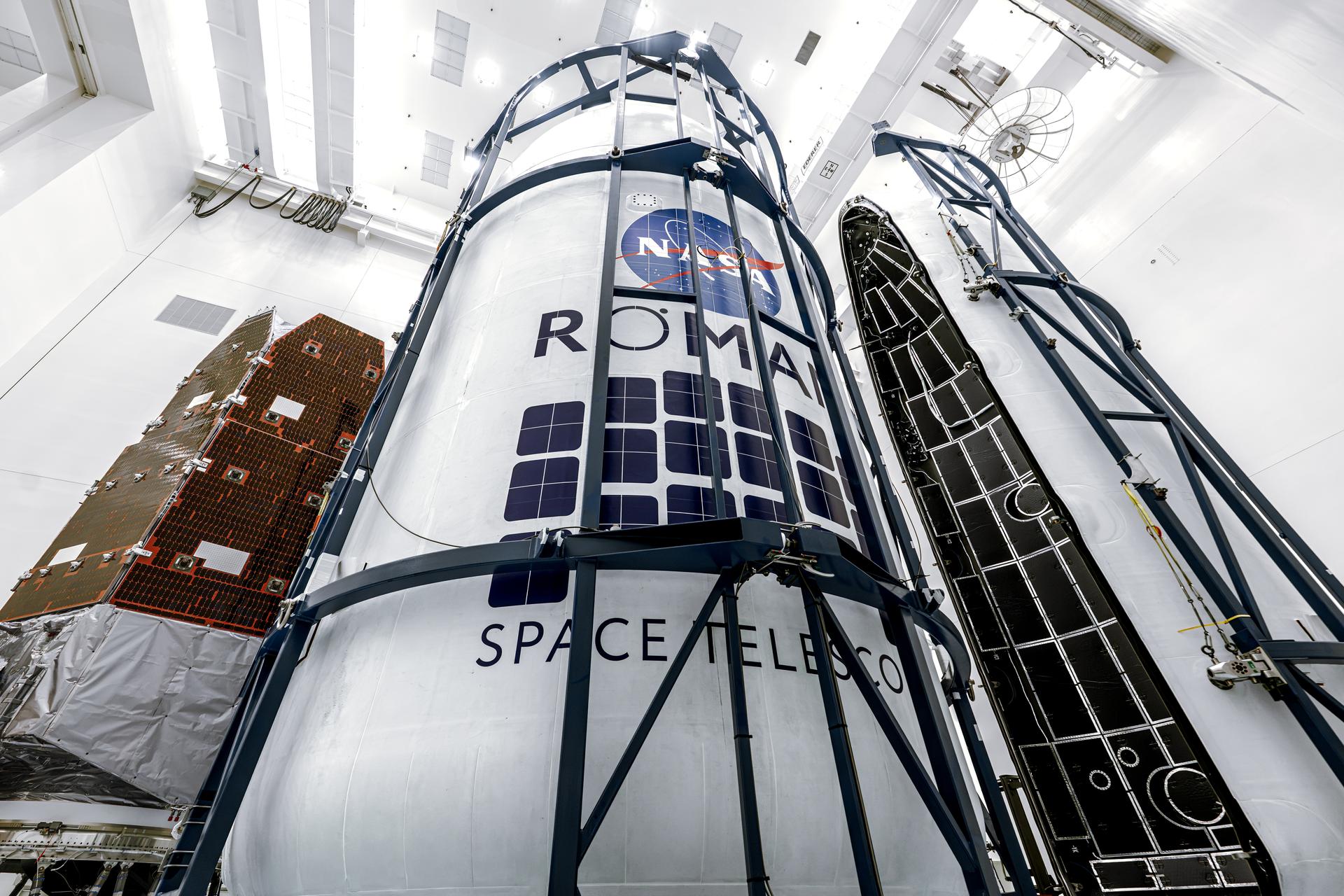
KENNEDY SPACE CENTER — The $4 billion observatory will launch aboard a SpaceX Falcon Heavy rocket from Launch Complex 39A in Florida. The Falcon Heavy rocket uses three connected rocket boosters to provide thrust. Teams enclosed the telescope inside the protective fairing of the rocket at the Payload Hazardous Servicing Facility on Aug.
21, 2026. The payload fairing stands 43 feet tall. SpaceX plans to recover both fairing sections after they return to Earth.
The Roman Space Telescope is named for NASA’s first chief astronomer. Its science instruments are designed to help researchers understand dark energy. The telescope will map how galaxies form, cluster, and evolve by tracing the influence of dark matter.
The main survey is expected to cover more than two billion galaxies and take more than a year. The telescope has a field of view at least 100 times larger than the Hubble Space Telescope. While Hubble has observed about 0.1% of the night sky in its 35 years of operation, Roman will observe more than 12% of the night sky.
Roman Space Telescope science data will be publicly available after processing. The public may have a first look at Roman data in December 2026. Roman Space Telescope Deputy Project Scientist Ori Fox described the mission's role in an interview.
"Once you see something in that landscape that's interesting, you can then zoom in," he said. "But you need a zoom lens. That zoom lens is your Hubble or Webb." He added, "We really hope that these datasets will be so expansive and wide that beyond the primary questions that we're trying to answer, you'll be able to answer a whole slew of other questions."
The telescope will discover and characterize exoplanets, with researchers expecting it to find thousands. It will also study black holes and explore objects from the solar system to the edge of the observable universe. Roman will test advanced technology designed to directly image planets around nearby stars.
The Roman Coronagraph Instrument uses a series of masks and mirrors, including two deformable mirrors, to suppress starlight. Technology called Multi-Star Wavefront Control was developed by researchers at NASA Ames to suppress light from multiple stars and reveal hidden exoplanets. Multi-Star Wavefront Control masks are included on the coronagraph’s flight instrument as an added capability beyond baseline observation modes.
Innovative software called ROSALIA was developed by a team at NASA Ames, with collaborators at NASA’s Goddard Space Flight Center and IPAC/Caltech, to improve Roman’s images and optimize observing plans. ROSALIA software predicts and removes unwanted light, including zodiacal and stray light, from images captured by Roman’s Wide Field Instrument. NASA’s Advanced Supercomputing Division at Ames provides advice and guidance to the Roman project on data pipelines and mission operations.
Why It Matters
The Nancy Grace Roman Space Telescope represents a significant expansion in observational capacity, with a field of view at least 100 times larger than the Hubble Space Telescope. While Hubble has observed about 0.1% of the night sky in 35 years, Roman is positioned to observe more than 12% of the sky. The mission's main survey is expected to cover more than two billion galaxies over more than a year, providing datasets that mission representatives describe as expansive enough to answer questions beyond the primary scientific objectives.
The telescope acts as a wide-field surveyor, allowing other instruments like Hubble or the James Webb Space Telescope to serve as follow-up tools for specific targets. This approach enables researchers to identify interesting phenomena across a vast landscape and then examine them in detail. The mission also advances technology for directly imaging exoplanets through instruments like the Roman Coronagraph and software such as ROSALIA, which improves image quality by removing unwanted light.
Timeline
Mission leaders from NASA, the Roman Space Telescope team, and SpaceX met on Friday for a Flight Readiness Review at Kennedy Space Center on Aug. 21, 2026. Teams enclosed the Roman Space Telescope inside the protective fairing of its SpaceX Falcon Heavy rocket at the Payload Hazardous Servicing Facility on Aug.
21, 2026. NASA’s Nancy Grace Roman Space Telescope, encapsulated in its payload fairing, traveled from the Payload Hazardous Servicing Facility to the SpaceX hangar at Launch Complex 39A at NASA’s Kennedy Space Center on Tuesday, Aug. 25, 2026. NASA Administrator Jared Isaacman is expected to fly past the Nancy Grace Roman Space Telescope and Falcon Heavy rocket on the launchpad in his jet at 11:45 a.m. EDT on Saturday, Aug. 29, 2026.
NASA and SpaceX are targeting liftoff for no earlier than 7:26 a.m. EDT on Sunday, Aug. 30, 2026. Launch coverage begins at 6:20 a.m. EDT on Sunday, Aug.
30, 2026. A postlaunch news conference is scheduled for 9:30 a.m. EDT on Sunday, Aug. 30, 2026.
What's New
Additional reporting confirms that mission leaders from NASA, the Roman Space Telescope team, and SpaceX met on Friday for a Flight Readiness Review at Kennedy Space Center. Teams enclosed the Roman Space Telescope inside the protective fairing of its SpaceX Falcon Heavy rocket at the Payload Hazardous Servicing Facility on Aug. 21, 2026. Following the Flight Readiness Review, mission managers certified that the Roman Space Telescope is ready to proceed with remaining work before launch. After launch and separation from the rocket, the Roman Space Telescope will travel to the second Sun-Earth Lagrange point (L2), about one million miles from Earth.
Roman Space Telescope Deputy Project Scientist Ori Fox provided context on the mission's strategy in recent comments. "Once you see something in that landscape that's interesting, you can then zoom in," Fox said. "But you need a zoom lens. That zoom lens is your Hubble or Webb." Fox further stated, "We really hope that these datasets will be so expansive and wide that beyond the primary questions that we're trying to answer, you'll be able to answer a whole slew of other questions."


forum Comments (0)
No comments yet. Be the first to comment.