
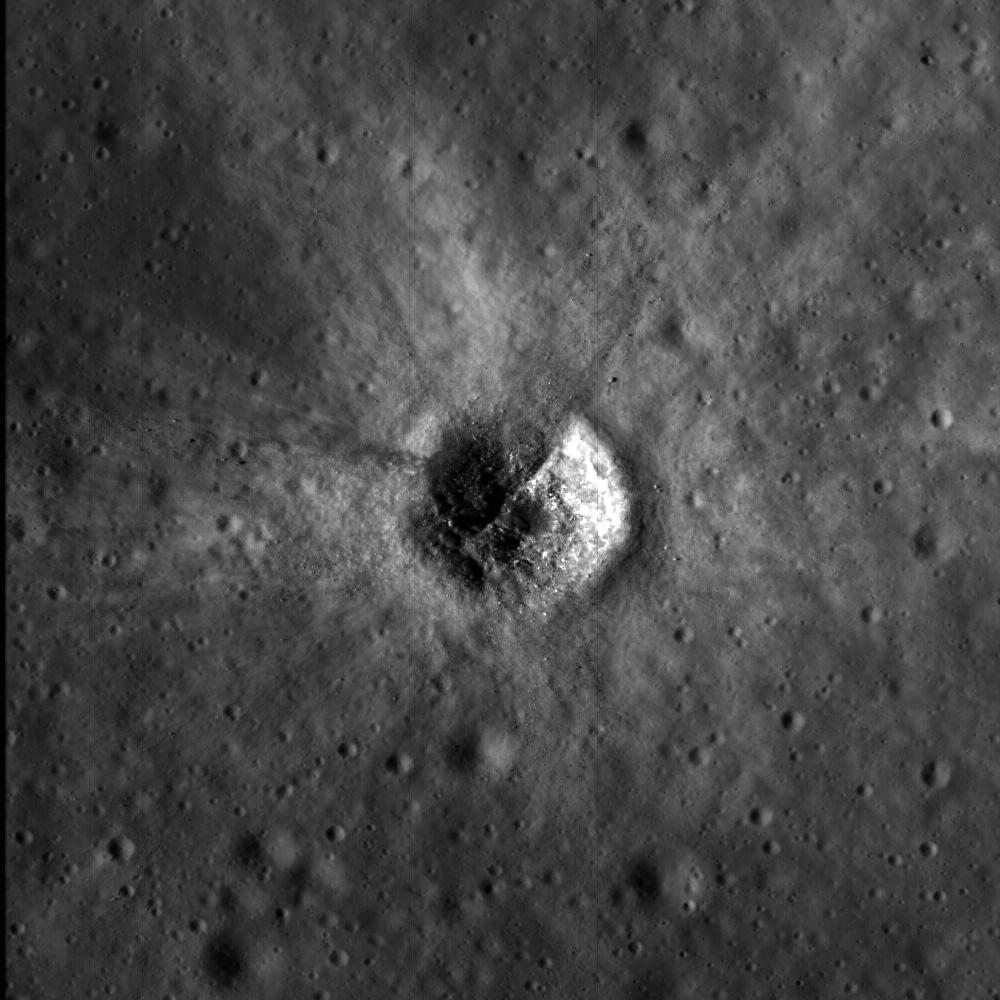
MOON — NASA released before-and-after images of the impact site on August 19, 2025. The Lunar Reconnaissance Orbiter captured images of the crater between August 11 and August 12, 2025.
Engineers tilted the Lunar Reconnaissance Orbiter to point its cameras at the impact site while the spacecraft traveled at 1 mile per second at an altitude of 60 miles. It took six days for the Lunar Reconnaissance Orbiter's orbit to align with the impact site for imaging.
The center of the impact crater is located at coordinates 19.4759°N, 266.7138°E at an elevation of 511 meters. The darker streaks radiating from the crater consist of surface dust and rocks altered by solar wind and cosmic rays, excavated from a depth of approximately 1.5 feet. The brighter streaks radiating from the crater consist of fresh material excavated from deeper underground.
South Korea's Danuri spacecraft imaged the crater shortly after the impact, confirming the predicted location within 0.6 miles. The European Southern Observatory's Very Large Telescope in Chile detected the impact plume.
SpaceX stated that solar activity and gravity caused the second stage to drift toward the Moon over time. "This is not something we’re really concerned about. This is actually a technically accepted and safe method of disposing of hardware in low lunar orbit," NASA Lunar Scientist Kelsey Young said.
Why It Matters
The Lunar Reconnaissance Orbiter has been orbiting the Moon since 2009. The Lunar Reconnaissance Orbiter has imaged at least three lunar impact sites, including the 2009 LCROSS impact, the 2022 Chang’e-5 T1 collision, and the 2025 SpaceX Falcon 9 impact, demonstrating its role in monitoring cislunar debris impacts.
The 2025 SpaceX upper stage impact released energy equivalent to approximately 1.2 tons of TNT, based on its 5,400 mph velocity and estimated mass of 4,000 kg, according to trajectory analysis by NASA’s Jet Propulsion Laboratory. The 2025 SpaceX impact is predicted to create a crater between 20–30 meters in diameter, based on modeling of the 2009 LCROSS impact (22 meters) and the 2022 Chang’e-5 T1 impact, which produced a 22-meter crater.
Timeline
The Lunar Reconnaissance Orbiter has been orbiting the Moon since 2009. The impacting rocket stage was the upper stage from a January 2025 launch that carried two private lunar landers. The upper stage of a SpaceX Falcon 9 rocket impacted the Moon on August 5, 2025. SpaceX stated that solar activity and gravity caused the second stage to drift toward the Moon over time. This event is only the second known case of a rocket body unintentionally impacting the lunar surface. The rocket stage impacted the lunar surface at a speed of 5,400 miles per hour. South Korea's Danuri spacecraft imaged the crater shortly after the impact, confirming the predicted location within 0.6 miles. NASA's Center for Near Earth Object Studies refined the rocket's trajectory using publicly available data to predict the impact location.
What's New
The Lunar Reconnaissance Orbiter (LRO) was launched on an Atlas 5 rocket in 2009, the same vehicle that carried NASA’s LCROSS mission, which deliberately impacted the Moon in 2009 to search for water ice. The SpaceX Falcon 9 upper stage that impacted the Moon was part of the. The 2025 SpaceX Falcon 9 upper stage impact is the second unintentional lunar collision recorded, following the 2022 Chang’e-5 T1 upper stage impact, according to data from NASA’s Center for Near Earth Object Studies.
The Korean Aerospace Research Institute’s Danuri spacecraft captured images of the impact site after the SpaceX Falcon 9 upper stage collided with the Moon on August 5, 2026. The Lunar Reconnaissance Orbiter has imaged at least three lunar impact sites, including the 2009 LCROSS impact, the 2022 Chang’e-5 T1 collision, and the 2025 SpaceX Falcon 9 impact, demonstrating its role in monitoring cislunar debris impacts. SpaceX stated that solar activity and gravity caused the second stage to drift toward the Moon over time. The 2022 impact of China’s Chang’e-5 T1 mission upper stage on the Moon created a double crater, likely due to the stage’s decapitation upon impact, marking the first known unintentional lunar collision involving a non-U.S. rocket body. The 2025 SpaceX impact is predicted to create a crater between 20–30 meters in diameter, based on modeling of the 2009 LCROSS impact (22 meters) and the 2022 Chang’e-5 T1 impact, which produced a 22-meter crater.
How Sources Differ
Sources differ on the details regarding the rocket that impacted the moon. One source states the Lunar Reconnaissance Orbiter (LRO) was launched on an Atlas 5 rocket in 2009, the same vehicle that carried NASA’s LCROSS mission, which deliberately impacted the Moon in 2009 to search for water ice. Another source states the upper stage of a SpaceX Falcon 9 rocket impacted the Moon on August 5, 2025.
Sources also present different information regarding the SpaceX Falcon upper stage. One source notes the SpaceX Falcon 9 upper stage that impacted the Moon was part of the. Another source states the 2025 SpaceX Falcon 9 upper stage impact is the second unintentional lunar collision recorded, following the 2022 Chang’e-5 T1 upper stage impact, according to data from NASA’s Center for Near Earth Object Studies.
There are differences regarding the SpaceX Falcon upper stage impact. One source states the 2025 SpaceX Falcon 9 upper stage impact is the second unintentional lunar collision recorded, following the 2022 Chang’e-5 T1 upper stage impact, according to data from NASA’s Center for Near Earth Object Studies. Another source states the Korean Aerospace Research Institute’s Danuri spacecraft captured images of the impact site after the SpaceX Falcon 9 upper stage collided with the Moon on August 5, 2026.
Sources provide different details regarding the Lunar Reconnaissance Orbiter and NASA. One source states the Lunar Reconnaissance Orbiter (LRO) was launched on an Atlas 5 rocket in 2009, the same vehicle that carried NASA’s LCROSS mission, which deliberately impacted the Moon in 2009 to search for water ice. Another source states NASA plans to observe the impact site with its Lunar Reconnaissance Orbiter after the impact, according to the official record.
Sources provide different details regarding the Lunar Reconnaissance Orbiter and the Moon. One source states the Lunar Reconnaissance Orbiter (LRO) was launched on an Atlas 5 rocket in 2009, the same vehicle that carried NASA’s LCROSS mission, which deliberately impacted the Moon in 2009 to search for water ice. Another source states the Lunar Reconnaissance Orbiter has been orbiting the Moon since 2009.
Sources provide different details regarding the SpaceX Falcon upper stage that impacted the Moon. One source states the SpaceX Falcon 9 upper stage that impacted the Moon was part of the. Another source states the upper stage of a SpaceX Falcon 9 rocket impacted the Moon on August 5, 2025.
Sources provide different details regarding the SpaceX Falcon upper stage. One source states the 2025 SpaceX Falcon 9 upper stage impact is the second unintentional lunar collision recorded, following the 2022 Chang’e-5 T1 upper stage impact, according to data from NASA’s Center for Near Earth Object Studies. Another source states the upper stage of a SpaceX Falcon 9 rocket impacted the Moon on August 5, 2025.
Sources provide different details regarding the upper stage impact and unintentional lunar collision. One source states the 2025 SpaceX Falcon 9 upper stage impact is the second unintentional lunar collision recorded, following the 2022 Chang’e-5 T1 upper stage impact, according to data from NASA’s Center for Near Earth Object Studies. Another source states the 2022 impact of China’s Chang’e-5 T1 mission upper stage on the Moon created a double crater, likely due to the stage’s decapitation upon impact, marking the first known unintentional lunar collision involving a non-U.S. rocket body.


forum Comments (0)
No comments yet. Be the first to comment.