
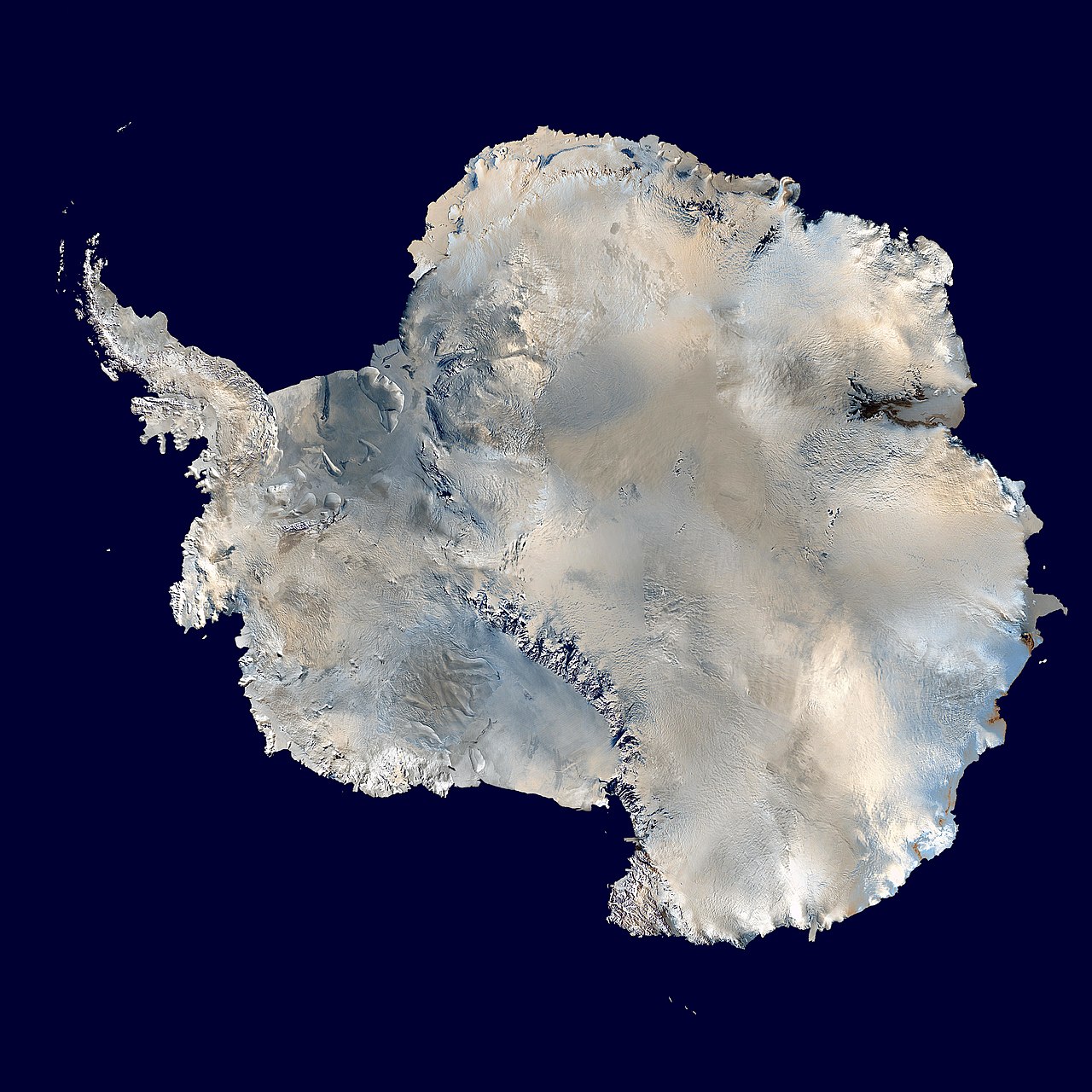
ANTARCTICA — The European Space Agency temporarily positioned its Copernicus Sentinel-1C and Sentinel-1D radar satellites in a close tandem formation. This configuration achieved a one-day repeat-pass interval for observations of Antarctica, enabling the measurement of glacier motion and the pinpointing of the grounding line.
The tandem setup supported the cross-calibration of the two satellites and verified interferometric synthetic aperture radar performance. Comparisons between the current Sentinel-1C–Sentinel-1D measurements and earlier ERS tandem phase measurements provide insights into changes in Antarctica over three decades.
Dirk Geudtner, ESA's Sentinel-1 System Manager, said, "The near-simultaneous observations from the three Sentinel-1 satellites provided a rare opportunity to monitor glacier and ice-sheet dynamics across different timescales." He added, "In particular, by imaging the same region of Antarctica just one day apart, the Sentinel-1C and Sentinel-1D satellites recreated the observation time interval that made the original ERS-1–ERS-2 tandem mission a breakthrough for measuring glacier motion and mapping grounding lines."
The ERS-1 satellite launched in 1991, followed by ERS-2 in 1995. Shortly after ERS-2 entered orbit, ESA maneuvered both satellites into a tandem formation that allowed observation of the same area 24 hours apart; this arrangement was maintained for nine months. Another tandem campaign involved ERS-2 and the Envisat satellite in 2008. Before Sentinel-1A's retirement, ESA operated it with Sentinel-1C in a standard six-day repeat-pass configuration.
An interferogram from the Sentinel-1C–Sentinel-1D configuration revealed major fractures and rifts in the Scar Inlet Ice Shelf that were not visible in the 1995 ERS-1–ERS-2 interferogram. The Scar Inlet Ice Shelf is the southern remnant of the former Larsen-B Ice Shelf. Measurements indicate a substantial increase in Leppard Glacier's ice-flow velocity between 1995 and 2026. The weakening of the ice shelf has contributed to the acceleration and thinning of tributary glaciers, increasing ice discharge and driving inland migration of the grounding line. A grounding line marks where a glacier or ice sheet transitions from resting on bedrock to floating on the ocean.
Helmut Rott, Professor Emeritus, said, "Detailed observations of such features and their temporal change, as provided by the ERS-1–ERS-2 and Sentinel-1C–Sentinel-1D one-day repeat data, opens excellent opportunities for improved understanding and predictions of processes of ice-shelf weakening and disintegration, grounding line migration and loss of grounded ice." The one-day interferogram was acquired on March 22 and 23, 2026, while a standard six-day interferogram was acquired on March 22 and 28, 2026.
The 'double-difference' interferogram, derived from two Sentinel-1C–Sentinel-1D pairs, reveals tidal ice deformation and shear zones. The Evans Ice Stream, which drains the southern Antarctic Peninsula into the Ronne Ice Shelf at speeds of around 3–4 meters per day, has been proposed as a calibration and validation site for polar ice-sheet products from the upcoming Copernicus ROSE-L mission. Thibaut Decoopman, ESA's Sentinel-1 and Sentinel-1 Next Generation Project Manager, said, "Sentinel-1 has established a benchmark for high-quality, end-to-end radar interferometric performance." He added, "Building on this success, Sentinel-1 Next Generation will secure the continuity of C-band observations while providing enhanced performance to address the evolving needs of users and Copernicus services."


forum Comments (0)
No comments yet. Be the first to comment.