
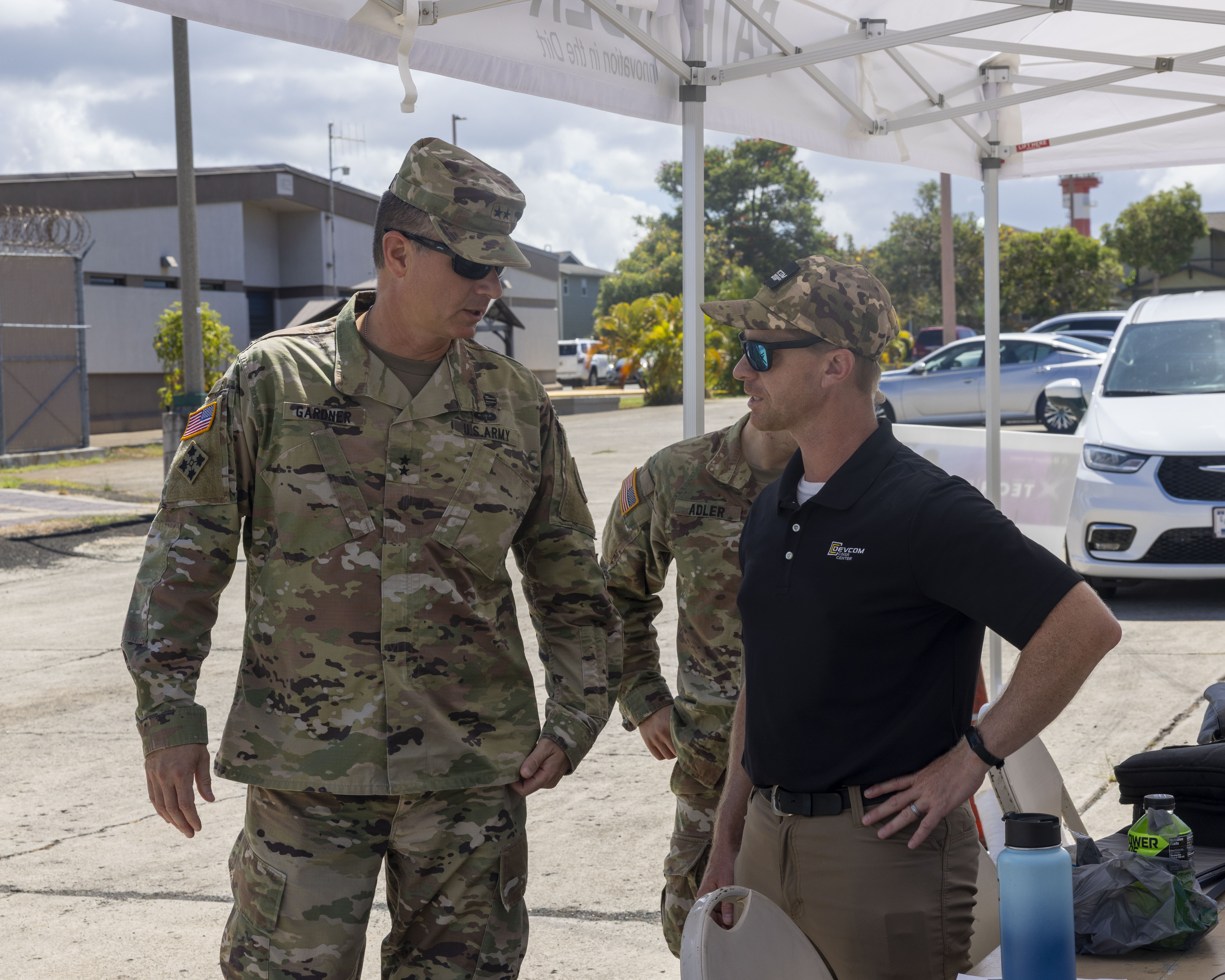
INDO-PACIFIC — The Army's 8th Theater Sustainment Command is using artificial intelligence for supply chain management and autonomous watercraft in the Pacific region.
Maj. Gen. Gavin Gardner, commander of the 8th Theater Sustainment Command, said the unit leverages AI "to help us make better-informed decisions" for supply chain management. "When resources are not unlimited, how do you best look at demand analysis over time and space, and stock forward the right things versus stocking everything? Because we just can't afford to do that," Gardner said. "And so we're using AI right now to help us see that." The command works with commercial partners for regional warehouse management and supply delivery timing. "I'm looking at partners, and I'm talking to partners that do that on a global scale, because the distances between the continental United States to the forward positions that we train or live at, like the Republic of Korea or Japan, we're constantly looking for smarter ways to do that," he said.
Gardner indicated the command seeks between 30 and 100 medium-sized autonomous vessels for use in the U.S. Indo-Pacific theater, with proposed berthing locations including Korea, Japan, the Philippines, Australia, Singapore, and Thailand. The command is working with industry to develop and test larger, faster autonomous vessels. "We have industry partners that are creating vessels right now in the water that are over 100 feet long that would move anywhere between four and eight 20-foot equivalent units... think the containers you see moving up and down most of your ports today," Gardner said. "That capability is already in play, and it's going through experimentation now, and the 8th TSC, along with the rest of the United States Army, is looking to partner, test, and innovate those autonomous watercraft first out in our region, because if you can work in the Pacific, you can work anywhere in the world."
Current U.S. maritime laws require a minimum crew size for vessels, limiting autonomous operations to testing or pilot programs. Gardner said, "We need to get the laws of the sea that our Coast Guard currently use to mandate watercraft operations that currently have to be manned when it enters into a port, that we're comfortable having unmanned systems enter into ports, so that we can rapidly receive and download autonomous watercraft like we do manned watercraft today."
The unit operates one Maneuver Support Vessel (Light), a manned landing craft designed to replace the Vietnam-era Landing Craft Mechanized-8. The vessel is nearly four times faster than the older watercraft and operates in shallower waters. The unit has tested the vessel for approximately nine months to gather data for future design. The command has rehearsed operations with the 25th Infantry Division and the 3rd Multi-Domain Task Force, placing multiple Marine NMESIS anti-ship systems onto the vessel. "So I'm actually going to different sets of beaches, and so you can put up to two HIMARS onto an MSV-Light, approach a beach very rapidly, bring it into position, download it, and then those platforms can get off and do their fire missions," Gardner said.


forum Comments (0)
No comments yet. Be the first to comment.