
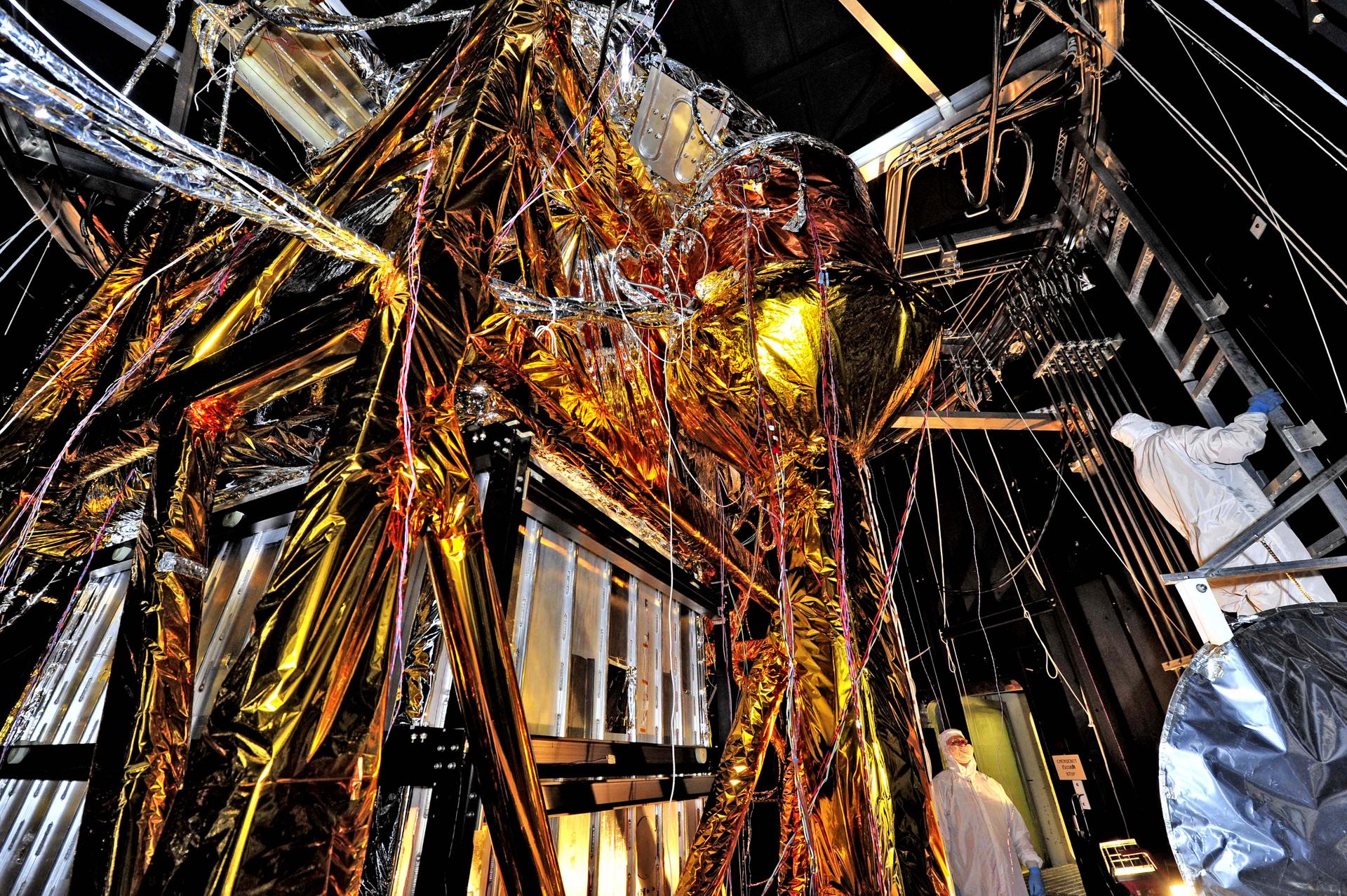
SPACE — NASA's Galileo probe failed to fully deploy its high-gain antenna in 1991, an incident widely attributed to cold welding. The phenomenon occurs when two metal plates in the vacuum of space fuse into a single piece of metal.
Cold welding is a known hazard for spacecraft engineers. A lack of oxygen in space contributes to this effect. On Earth, metal surfaces are typically coated in an oxide layer, a few atoms thick, which forms when metal is exposed to oxygen. "Once the oxide is formed, it's over. Then it can't cold weld anymore, because the oxygen basically passivates these bonds," said Julia Greer, a materials scientist at Caltech. This thin oxide layer acts as an insulating wrapper.
Metals are composed of lattices where atoms are bonded. Atoms near the surface are not bonded on their outward-facing side. Without an oxide layer, surface atoms from two separate metal pieces can share electrons, bonding them together. "Those electrons don't know if it's in this piece or if it's in that piece, so they begin sharing the electrons, and essentially that cold welds things together," said Sven Bilén, a professor of engineering design and aerospace engineering at Penn State.
In space, harsh conditions can remove this protective layer. There is no oxygen to rebuild the oxide layer on metal surfaces once it is stripped away. Bombardment from solar and ionic radiation in orbit can scour metal surfaces clean, leaving freshly exposed atoms primed to bond. Additionally, pressing two metal surfaces together, especially with sliding or vibration, can shear off the oxide layer. "You're breaking up the surface oxide, and you're forming metallurgical bonds," said Zachary Cordero, an aerospace engineer at MIT.
The Galileo probe, launched in 1989, experienced difficulties when engineers attempted to deploy its high-gain antenna in 1991, and it never fully opened. Lubricant loss and launch vibrations are believed to have stripped the oxide layer from parts of the antenna, facilitating cold welding. "If there is cold welding, things can become stuck in place. If you have a deployable structure and there's cold welding, you might freeze the mechanism, or a door might become locked, or something might become immobilized, which you don't want," Cordero said.
Engineers employ several strategies to mitigate cold welding. Gold and platinum, for example, do not form an oxide layer, even on Earth, making them prone to cold welding. "Gold definitely is a very notorious metal for cold welding," Greer said, noting its softness allows it to conform easily to surfaces. To prevent fusion, engineers use processes like anodizing to lock an artificial oxide layer onto metal. They also apply dry lubricants, such as molybdenum disulfide, to physically separate surfaces. Pairing dissimilar metals can also prevent cold welding. "Their packing order is not quite perfectly aligned, and so there'll be a lot more energetic kind of barrier to overcome," Greer said. Before launch, spacecraft hardware undergoes rigorous testing, including shaking on vibration tables and cycling through extreme hot-and-cold swings in vacuum chambers, to simulate the stresses of liftoff and orbit. Cold welding can also occur in vacuum conditions on Earth.



forum Comments (0)
No comments yet. Be the first to comment.